
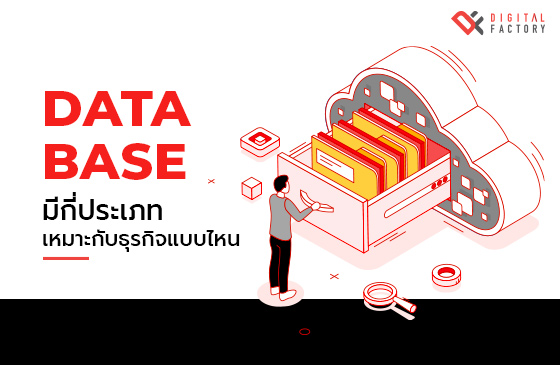
A database can be compared to a large storage system where data is organized systematically, allowing it to be accessed, edited, and analyzed efficiently.
Imagine a large library that categorizes books into different sections such as literature, science, or history. A database works in a similar way. However, instead of storing books, it stores various types of data—such as customer information, product details, sales records, or any other data you need to keep and manage.

How Many Types of Databases Are There?
Databases come in various types, each designed to support different data structures, data volumes, and methods of accessing and managing information. Choosing the right database depends on the specific needs of an organization or project. So, let’s explore the main types of databases.
1. Network Database
A Network Database is a type of database that evolved from the Hierarchical Database model. It has a more complex and flexible structure, allowing multiple relationships between data to be represented more effectively.
Example: An insurance company database that can clearly show relationships between customers, sales representatives, policy types, and claims.
2. Hierarchical Database
A Hierarchical Database is designed with a tree-like structure. Data is organized into clear levels with parent-child relationships. Each child record has only one parent, but a parent can have multiple child records.
Example: An organizational structure where a company uses a hierarchical database to represent relationships between employees within the organization.
3. Relational Database
A Relational Database is the most widely used type of database today. It stores data in tables that are related to one another, similar to spreadsheets in Excel, but with much more advanced capabilities for managing and analyzing complex data.
Example: Banks use relational databases to manage customer information, account details, and transaction records. Governments use them to store population data, tax records, and traffic information.
4. Object-Oriented Database
An Object-Oriented Database applies the concept of Object-Oriented Programming (OOP) to data storage and management. In this model, everything is treated as an object that can contain both data and relationships.
Example: Multimedia data storage, where images, audio, videos, and related information are stored as objects.
5. NoSQL Databases
NoSQL (Not Only SQL) databases do not use a table-based structure like relational databases. Their key strength is flexibility. They can store structured, semi-structured, and unstructured data, making them well-suited for modern applications that handle large volumes of diverse data.
Example: Social media platforms that store user data, posts, and relationships between users, or mobile applications that store user information and usage data.
6. Cloud Database
A Cloud Database is a database system that runs on cloud computing infrastructure. Instead of installing and maintaining a database on an organization’s own servers, businesses use database services provided by cloud providers such as Amazon Web Services (AWS), Microsoft Azure, or Google Cloud Platform.
What Are the Components of a Database System?
A database system consists of several key components that work together to store, manage, and retrieve data efficiently. The main components are as follows:
1. Hardware
Hardware is a fundamental part of a database system. It includes the Central Processing Unit (CPU), which processes commands and performs calculations; main memory (RAM), which temporarily stores data currently in use for fast access; storage devices such as hard disk drives (HDDs) or solid-state drives (SSDs), which store database data for long-term use; and networking devices that connect the database system to other devices and users.
2. Software
Software includes the Database Management System (DBMS), which is responsible for creating, managing, and controlling databases. Examples include MySQL, PostgreSQL, and Oracle Database. To ensure the system operates efficiently, an operating system is required to manage hardware resources and provide services to application programs. Finally, application software allows users to directly access and manage data in the database, such as accounting systems or sales programs. These applications work together with the DBMS to enable users to interact with data conveniently.
3. Data
Data in a database system can be divided into three main types. First is raw data, which has not yet been organized or analyzed. Second is processed data, which is derived from analyzing and processing raw data to produce meaningful information that can be used effectively. Third is metadata, which describes other data—such as data types, formats, or sources. Metadata acts like labels that provide details about the data, making it easier to search, manage, and use efficiently.
4. Personnel
Several roles are involved in a database system. A Database Administrator (DBA) is responsible for designing the database structure, creating databases, and maintaining them to ensure optimal performance. Application developers build programs that connect to the database, enabling users to access and manage data as needed. Lastly, end users are individuals who use the database system to retrieve information or perform daily tasks related to data.
What Are the Benefits of a Database?
A database helps organize data systematically, reduce redundancy, improve accuracy, and enable fast and precise data retrieval. In addition, it allows multiple users to access and share data conveniently, with detailed control over access permissions.
Moreover, databases support data analysis to generate reports and identify trends that aid in decision-making. This ultimately enhances work efficiency, saves time, and minimizes errors in operations.
Conclusion
As we can see, databases are suitable for businesses of all sizes—whether small, medium, or large—because every business has data to manage. This may include customer information, product details, sales records, or other operational data essential to running the business effectively.
These data assets play a crucial role in advertising strategies. With our professional online advertising services, your business can fully leverage the power of data through in-depth analysis to develop targeted strategies that truly resonate with customers and drive higher sales for your business.