
The modern world is the era of data (Data). It is undeniable that almost every action you take is recorded and collected as massive amounts of data—whether it is online shopping, using social media, or even traveling via public transportation. These data become highly valuable assets for organizations and businesses.
Therefore, data science plays a crucial role in analyzing these vast amounts of data to uncover hidden insights and apply them to make more effective business decisions.

What Is Data Science?
Data Science is an interdisciplinary field that combines statistics, mathematics, computer science, and domain-specific knowledge to analyze large volumes of data—commonly referred to as Big Data. Its goal is to identify patterns and extract hidden insights that can be used to support business decision-making, drive innovation, and solve real-world problems in everyday life.
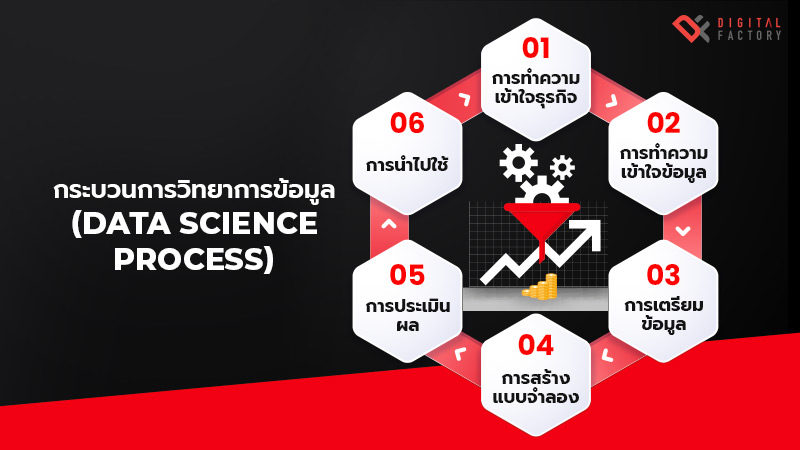
The Data Science Process
The Data Science process consists of structured steps that data scientists use to transform raw data into valuable insights and actionable outcomes. Generally, the process includes the following key stages:
1. Business Understanding
The first step in the Data Science process is understanding the business problem. This begins with clearly defining the issue to be solved, such as declining sales or customers switching to competitors. Next, measurable objectives are established—for example, increasing sales by 10% within six months. Relevant data is then identified and collected, such as customer data, sales records, or social media data, to analyze the root causes and determine potential solutions.
2. Data Understanding
Data understanding is a crucial stage in which data scientists explore and examine the data to ensure accurate analysis. This involves conducting an initial data exploration to identify data types (such as numerical, textual, or date formats), detect missing values, and check for errors or inconsistencies. Basic statistical analysis—such as calculating the mean, median, minimum, maximum, and quartiles—is then performed to understand data distribution and the characteristics of each variable.
3. Data Preparation
Data preparation ensures that the data is ready for analysis. This begins with data cleaning, which includes correcting errors (such as typos or illogical values) and handling missing data. The data is then transformed into suitable formats for analysis—for example, converting text into numerical values or standardizing measurement units. The final step is feature engineering, where new variables are created from existing data to improve analytical accuracy, such as deriving “age” from a date of birth.
4. Modeling
Once the data has been prepared, the next step is building and developing analytical models. This starts with selecting appropriate techniques based on the problem—for example, predictive techniques for forecasting future outcomes, or clustering techniques for grouping data. A mathematical model is then constructed and trained using the prepared data, enabling it to learn patterns and relationships within the dataset.
5. Evaluation
Model evaluation measures how well the model performs by comparing its results with actual data. This helps assess accuracy and overall effectiveness. After evaluating performance, data scientists interpret the findings to uncover meaningful insights and translate them into conclusions or recommendations for solving problems or improving business performance.
6. Deployment
The final stage of the Data Science process is deployment. This involves presenting the analytical results to stakeholders, which may be done through reports, dashboards, or presentations. In addition, the developed model can be implemented in real-world applications, such as powering product recommendation systems, forecasting business outcomes, or supporting strategic decision-making. This allows organizations to effectively utilize data-driven insights to enhance operations and drive continuous improvement.

What Skills Are Required for Data Science?
To become a successful data scientist, one must possess a combination of technical expertise and essential soft skills. These skills enable professionals to analyze large volumes of data effectively and create meaningful value. They can be broadly categorized into two main types:
1. Technical Skills (Hard Skills)
- Mathematics and Statistics : A strong foundation in mathematics and statistics is essential for understanding data and interpreting results. This includes basic statistics, linear algebra, calculus, and probability theory.
- Programming Skills : Common programming languages in Data Science include Python and R. Python is especially popular due to its wide range of libraries and tools for data analysis, such as NumPy, Pandas, Matplotlib, and Scikit-learn.
- Database Management : Knowledge of SQL is necessary for retrieving data from relational databases, while familiarity with NoSQL is important for handling unstructured or semi-structured data.
- Machine Learning : Understanding various algorithms such as linear regression, classification, and clustering is crucial for building predictive and analytical models.
- Data Visualization : The ability to present data through charts, graphs, and dashboards helps communicate insights clearly and effectively
2. Soft Skills
- Problem-Solving Skills : The ability to analyze complex problems systematically and identify effective solutions.
- Critical Thinking : The capacity to evaluate data and results from multiple perspectives.
- Communication Skills : The ability to explain analytical findings clearly to non-technical stakeholders.
- Teamwork : The ability to collaborate effectively with cross-functional teams.
- Curiosity : A strong desire to continuously learn and stay updated with new technologies and advancements
Conclusion
In summary, Data Science is a powerful tool for driving businesses forward in the digital era. Applying Data Science to marketing enables businesses to compete more effectively and achieve sustainable growth.
And of course, our marketing strategy services will help your business fully harness the power of data through in-depth analysis, enabling you to create customer-focused strategies and increase your sales.