
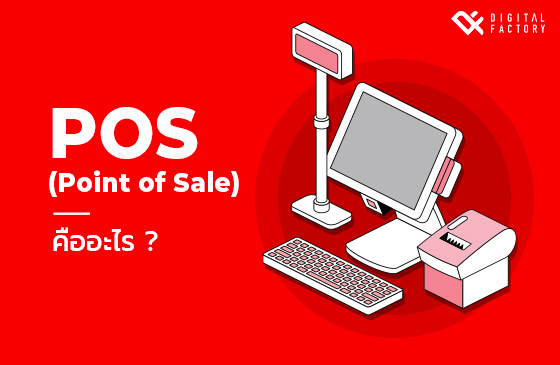
In today’s digital era, where technology drives every industry, businesses are increasingly adopting POS systems to improve operational efficiency and enhance customer experience. With a wide range of functions—such as inventory management, sales analysis, and online channel integration—POS has become an essential tool that supports sustainable business growth.
In this article, Digital Factory will introduce you to What Is a POS Program? and explore its benefits beyond being just a traditional cash register.
What is POS (Point of Sale)?
POS stands for Point of Sale, also known as a retail management system. It is a technology system designed to facilitate the sale of products and services within a store. A POS system supports various functions, including recording sales transactions, managing inventory, issuing receipts, and collecting customer data. This information can then be analyzed to further develop and improve the business.
Benefits of a POS System That Help Drive Your Business Forward
A POS system offers numerous advantages that can elevate your business, including improved operational efficiency, accurate inventory management, data-driven decision-making, enhanced customer satisfaction, and support for multiple payment methods. Here are the details:
1. Improved Operational Efficiency
A POS system significantly enhances workflow efficiency. It reduces transaction time, speeds up the sales process, and minimizes errors in calculations and data entry—ensuring accurate and reliable information.
Additionally, automation features such as automatic calculations and receipt generation reduce employees’ workload, allowing staff to focus more on customer service.
2. Accurate Inventory Management
With a POS system, you can monitor inventory levels in real time. This ensures precise stock tracking and helps prevent both stock shortages and overstocking.
As a result, purchasing plans become more efficient, and costs related to stockouts or damaged excess inventory can be minimized.
3. Data Analysis for Better Decision-Making
A POS system provides in-depth insights into your business performance. You can analyze daily, monthly, or yearly sales to identify best-selling and underperforming products.
It also helps you understand customer purchasing behavior, enabling you to refine marketing strategies. Furthermore, you can evaluate staff performance and use historical data to forecast future sales, supporting sustainable business planning.
4. Enhanced Customer Satisfaction
A POS system improves the overall customer experience by speeding up service, reducing wait times, and offering convenient payment options.
Moreover, collected customer data allows you to create personalized promotions, increasing customer satisfaction and encouraging repeat business.
5. Multiple Payment Options
Modern POS systems support a wide range of payment methods to meet diverse customer preferences. These include cash payments, credit and debit cards, e-wallets that align with modern lifestyles, and QR code payments for quick and seamless transactions.
Functions of a Restaurant POS System
A restaurant POS (Point of Sale) system is an all-in-one management tool designed to streamline restaurant operations. It improves staff efficiency and enables owners to analyze data to continuously enhance business performance. The key functions include:
1. Order Management
A POS system simplifies the order-taking process by allowing staff to input orders directly into the system quickly and accurately, reducing manual errors.
Menus can be customized flexibly—items can be added, edited, or removed, with adjustable pricing and ingredient details. Menu categories can also be organized for easier navigation and faster service.
2. Payment Processing
A POS system makes payments more convenient by supporting multiple payment methods, including cash, credit/debit cards, e-wallets, and QR code payments.
After payment is completed, the system instantly generates a receipt with clear details of ordered items and the total amount paid.
3. Inventory Management
The system automatically tracks ingredient and stock levels. Whenever a sale is made, inventory is deducted in real time.
It can also send alerts when ingredients are running low, allowing timely restocking. Additionally, sales data per menu item can be analyzed to optimize menus or create effective promotions.
4. Staff Management
A POS system simplifies employee management by assigning different access levels based on roles and responsibilities, ensuring secure and controlled system usage.
It also tracks employee performance, such as the number of orders handled or average serving time, enabling owners to evaluate and improve staff performance effectively.
5. Data Analytics
Restaurant owners can generate detailed sales reports—daily, weekly, or monthly—to monitor performance.
The system also analyzes customer purchasing behavior and menu popularity, helping refine marketing strategies, improve menu offerings, and design targeted promotions.
6. Integration with Other Devices
A POS system can integrate with various hardware devices to enhance operational efficiency, such as receipt printers, automatic cash drawers, and kitchen display systems (KDS).
Kitchen display screens clearly show incoming orders, helping kitchen staff prepare dishes accurately and quickly while minimizing errors and incorrect table service.
Conclusion
In summary, a POS system is an essential tool for effective business management. When data from the POS system is analyzed alongside strategic planning consultants, it can significantly support sustainable business growth.
Strategic consultants help interpret POS data and provide actionable recommendations to improve overall business performance. This may include developing marketing strategies, optimizing internal processes, and creating new products or services to strengthen competitiveness and drive long-term success.